Crowdsourcing Ideas for Community Development Projects: A Practical Guide
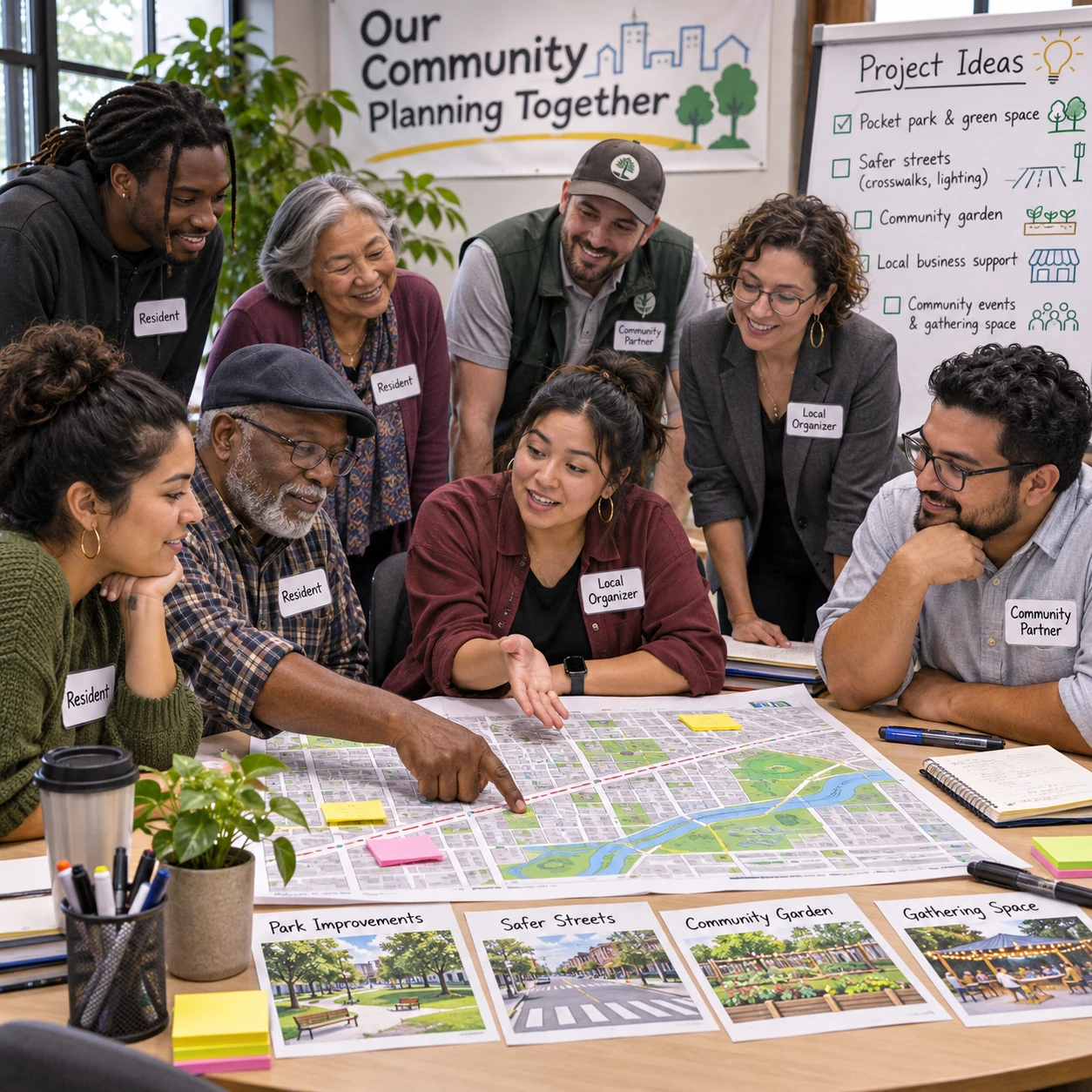
Community development projects are stronger when they respond to the people who live with their outcomes. Crowdsourcing gives residents and other local stakeholders a practical way to identify needs, suggest solutions, and shape priorities. Done well, it builds useful knowledge and community engagement. Done poorly, it can collect ideas without giving people a clear reason to trust the process.
This guide shows how social innovation teams can invite a broad range of voices, gather ideas through accessible methods, assess proposals transparently, and move selected ideas toward community-led action.
What Crowdsourcing Means in Community Development
Crowdsourcing in community development is a structured way to gather ideas and local knowledge from many people to address a shared need. It can reveal concerns that a project team might miss and help shape solutions around residents’ experience.
The “crowd” should include people affected by the issue, not simply whoever is easiest to reach. Depending on the project, that may mean residents, youth, elders, small-business owners, service providers, neighborhood associations, and people who face barriers to participation. Their perspectives can surface both the problem and the resources already present in the community.
Crowdsourcing works best as one part of ongoing community partnership. It can support participatory design, where community members help define, test, and improve a project, but a one-time call for suggestions is not a substitute for shared decision-making. A useful process has a visible path: ideas are collected, reviewed against stated criteria, and connected to a decision or next step. Not every idea will be adopted, and organizers should say so from the start.
Set a Clear Challenge and Invite the Right Voices
To invite useful community ideas, define a specific, open-ended challenge and identify who is affected by it. A clear question gives participants room to propose solutions without leaving them to guess what the project can realistically address.
Start by stating the issue, the project’s boundaries, and any constraints. For example: “How might we make the walk to the community center safer for children and older adults?” is more actionable than “How can we improve the neighborhood?” Explain what is fixed, such as the available budget or site, and what participants can influence.
Map local stakeholders before outreach. Ask who experiences the problem, who is often missing from public meetings, and who could help put a solution into practice. Use trusted community organizations, schools, libraries, tenant groups, and local service providers to reach people beyond established networks. Inclusive outreach takes more than posting an invitation online: offer translated materials, accessible venues, childcare or transportation support where feasible, and options for people with limited time or internet access.
Make participation expectations concrete. Tell people who will review submissions, when decisions are expected, and how participants will hear back. If the project cannot fund or implement every proposal, explain that early. Clear limits help protect trust while leaving room for creative ideas.
Choose Ways to Gather Ideas
Choose idea-gathering methods based on who needs to participate, what the challenge requires, and how much time people can give. Combining in-person and digital options usually reaches more people than relying on a single channel.
- Workshops: Small-group activities help participants build on one another’s ideas and explore trade-offs. Use short prompts, maps, or drawings so people do not need public-speaking confidence.
- Community meetings: Meetings can introduce the challenge and make discussion visible. Add small-group conversation or anonymous input to avoid giving the most vocal attendees control of the discussion.
- Surveys: Paper or online surveys are useful for collecting focused responses from many people. Keep questions brief, offer translated versions, and avoid treating the number of responses as proof that every group is represented.
- Digital platforms: Online idea boards, forms, or mapping tools allow people to contribute on their own schedule. They can be convenient, but exclude residents without reliable devices, connectivity, or confidence using the platform unless offline routes are available too.
Use the same core question across channels, then record responses in a consistent format. A simple submission template can ask: What is the idea? Who would benefit? What might be needed to try it? Avoid collecting sensitive personal information unless it is necessary and you can explain how it will be protected.
Make Participation Inclusive and Trustworthy
Inclusive participation requires accessible ways to contribute, honest expectations, and regular communication about what happens to ideas. People are more likely to take part when the process respects their time and makes the decision path visible.
Reduce practical barriers wherever possible. Choose familiar, accessible locations; provide interpretation or translated materials when needed; and offer phone, paper, and in-person ways to respond alongside digital platforms. Schedule sessions at different times if one meeting time would exclude shift workers, caregivers, or students. For online participation, use plain-language instructions and a mobile-friendly form.
Trust also depends on how the team handles disagreement and privacy. Set ground rules for respectful discussion, explain whether submissions will be public, and obtain permission before sharing someone’s story or photograph. Tell participants how ideas will be assessed and who makes the final decision. If officials, funders, or technical staff have approval authority, name that role rather than implying that voting alone determines the outcome.
Close the feedback loop with short updates: what you heard, what patterns emerged, which ideas are moving forward, and why others are not. Acknowledge gaps in representation and keep inviting people to participate. Transparency is a practice, not a single announcement at the end.
Evaluate and Prioritize Community Ideas
Prioritize community ideas with criteria shared in advance, such as local value, feasibility, equity, and alignment with project goals. A transparent review helps organizers compare proposals fairly without implying that a popular idea is automatically the most workable.
First, group similar submissions into themes without losing distinctive details. Then use a simple scoring rubric. For example, rate each idea from 1 to 5 on:
- Local value: Does it address a clearly expressed community need?
- Equity: Who benefits, and could the idea improve access for people facing the greatest barriers?
- Feasibility: Are the cost, skills, permissions, partners, and timeline realistic?
- Goal fit: Does it advance the project’s stated purpose?
- Learning potential: Can a small trial test the idea before a larger commitment?
Use scores to guide discussion, not to disguise judgment as mathematics. A proposal with broad appeal may still have risks; a less popular idea may address an urgent need for a group that was underrepresented in the process. Record the reasons behind decisions and invite community contributors to help review proposals when appropriate. When ideas compete, consider whether they can be combined, tested in stages, or referred to a partner better placed to lead.
Turn Selected Ideas into Action
Turn selected ideas into action by assigning an owner, defining the next step, and reporting progress back to contributors. A decision becomes meaningful when people can see who is responsible and what will happen next.
For each selected idea, create a short action brief that names the intended benefit, lead organization or team, community partners, resources needed, and first milestone. If uncertainty is high, start with a small pilot: test the idea in one location or with a limited group, gather feedback, then decide whether to adapt or expand it. A pilot is not always suitable, especially when safety, legal requirements, or urgent needs demand a more direct response, so match the method to the issue.
Invite contributors to stay involved in ways that fit their capacity. Some may help refine a design, connect the team to local knowledge, or review a prototype; others may prefer updates without taking on ongoing work. Do not assume that people who submitted ideas have volunteered to deliver them.
Share outcomes in accessible formats, including what changed, what did not, and what the team learned. If an idea cannot proceed, explain the reason and, when possible, identify another route or future opportunity. This is how crowdsourcing can support social innovation: not through idea collection alone, but by connecting local knowledge to accountable decisions and practical community-led work.
Frequently Asked Questions
How do you encourage people to share ideas?
Make the challenge specific, offer several low-barrier ways to respond, and explain how submissions will be used. Reach people through trusted local groups and follow up with visible updates. Personal invitations can help, but avoid implying that every suggestion will be funded or adopted.
What tools can communities use to collect ideas?
Communities can use workshops, paper forms, surveys, community meetings, phone conversations, and digital idea boards or online forms. The right tool depends on access, the type of question, and participants’ preferences. Pair online collection with offline options when digital access is uneven.
How should a project team choose between competing proposals?
Compare proposals using published criteria for community value, equity, feasibility, and fit with project goals. Document the reasoning, consider whether ideas can be combined or tested, and explain the final decision to participants.
How can organizers show participants that their input mattered?
Report what the team heard, describe which ideas influenced decisions, and give a clear reason when a proposal cannot move forward. Share project milestones and invite contributors to shape the next stage without assuming they can commit ongoing time.