How Design Thinking Methodologies Power Community-Driven Solutions
What Is Design Thinking in a Community Context?
Design thinking is a structured, human-centered problem-solving approach built around understanding real people before proposing any solution. In a community context, it means putting residents, patients, and local stakeholders at the center of every decision — not as subjects of research, but as the primary source of knowledge.
Most people encounter design thinking through corporate innovation workshops or tech product teams. That framing misses where the methodology actually shines: resource-constrained environments where the cost of getting it wrong is someone's health, livelihood, or safety. Social innovation projects in places like Haiti, rural India, or sub-Saharan Africa have quietly demonstrated that empathy-driven design produces solutions with far higher adoption rates than top-down interventions.
The core premise is disarmingly simple — you cannot design a solution for people you don't understand. Every technique, tool, and framework in the design thinking canon exists to close that gap between assumption and lived reality.
The Five Stages and How They Shift When People Are the Priority
The five stages of design thinking — empathize, define, ideate, prototype, and test — follow the same sequence whether you're building a mobile app or a low-cost medical device. What changes dramatically is what each stage requires when the end-user is a community member, not a paying consumer.
Empathize
In corporate settings, empathy often means user interviews and journey maps. In community-based projects, it means showing up consistently, building trust over weeks or months, and listening to things people wouldn't say in a formal interview. Practitioners working with iLab-style grassroots innovation labs often spend more time in the empathize phase than in all other stages combined — and that investment pays off in solutions people actually use.
Define
The define stage is where teams synthesize what they heard into a clear problem statement. The risk here is translation loss: the facilitator's interpretation of the community's problem can drift significantly from what was actually expressed. Good practice anchors the problem statement in direct quotes, observed behaviors, and community-validated needs — not assumptions dressed up as insights.
Ideate
Ideation works best when community members are in the room, not just the design team. Bringing together nurses, local manufacturers, and end-users in the same brainstorming session produces ideas that are immediately grounded in local materials, local skills, and local constraints. That kind of contextual knowledge cannot be imported from outside.
Prototype and Test
Prototyping and testing collapse into a tight feedback loop when done well. A rough physical model — even one made from cardboard or locally sourced materials — communicates far more than a slide deck. Testing it with real users in their actual environment, not a controlled setting, surfaces failure modes that no amount of planning would have caught.
Why Resource-Constrained Environments Are Ideal for Design Thinking
Scarcity is a creative forcing function. When teams cannot rely on expensive materials, specialized supply chains, or well-funded R&D departments, they have no choice but to innovate within real constraints — and that tends to produce solutions that are replicable, affordable, and maintainable by the communities they serve.
This is one of the genuinely counterintuitive insights in iterative problem-solving for development contexts: the limitations that look like disadvantages are often what make the outcome useful. A medical supply prototype designed for a clinic with no reliable electricity, limited storage space, and no trained biomedical engineers will be far more robust and appropriate than one designed in a fully equipped lab and shipped in.
Local knowledge compounds this advantage. Community members understand which materials are available, what repair skills exist nearby, and what cultural factors will determine whether something gets used or ignored. No outside expert can replicate that institutional knowledge, which is exactly why human-centered design in these environments is less about clever technology and more about rigorous listening.
3D Printing as a Prototyping Engine for Local Solutions
3D printing compresses the prototype-test cycle from weeks to hours, making it one of the most valuable tools available to community innovation labs. For teams working on medical supply access or assistive devices, that speed means more iterations, faster learning, and solutions that reach users sooner.
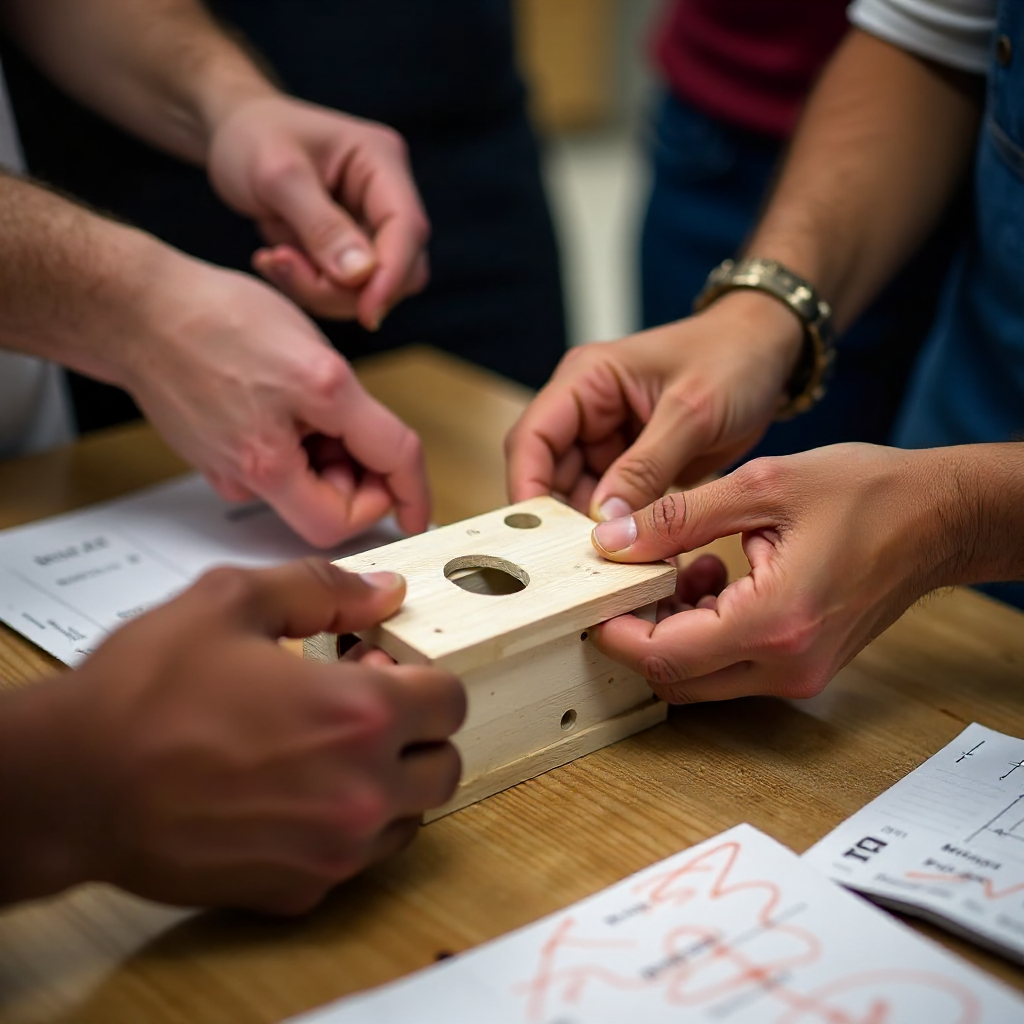
The real value of rapid prototyping with 3D printing isn't the technology itself — it's what it enables socially. When a community health worker can hold a physical object, turn it over, and say "this part doesn't work for how I actually use it," the design process becomes genuinely collaborative. Abstract feedback becomes concrete. Iterations happen in real time rather than across months of procurement and shipping cycles.
Projects focused on local production of medical supplies — splints, prosthetic components, equipment housings, sterilization tools — have shown that 3D-printed prototypes can transition directly into distributed manufacturing when the right infrastructure exists. A single machine and a trained local operator can produce items on demand, eliminating dependency on fragile international supply chains. The iLab Haiti model demonstrates exactly this: using desktop fabrication to close gaps in medical supply access that conventional procurement cannot address quickly enough.
One honest limitation: 3D printing requires consistent electricity, filament supply chains, and at least one person with technical maintenance skills. Building that capacity locally — rather than relying on visiting technicians — is what separates a sustainable program from a one-off demonstration.
Co-Designing With the Community: Moving From Consultation to Collaboration
The difference between consultation and genuine co-design is who holds decision-making power. Consultation extracts information from community members and returns a solution designed elsewhere. Community co-design keeps residents involved from problem framing through final iteration — and gives them real authority to reject, revise, or redirect the work.
Extractive research is a persistent problem in social innovation. Teams arrive, conduct interviews, leave with data, and return months later with a prototype that solves a slightly different problem than the one the community described. This pattern erodes trust and produces adoption rates that make otherwise well-funded projects look like failures.
Practical co-design requires deliberate stakeholder engagement structures. That means scheduled co-creation sessions — not just feedback rounds — where community members contribute ideas, evaluate options, and flag constraints the design team wouldn't know to ask about. It means compensating participants for their time and expertise. And it means being willing to scrap a promising prototype when community testing reveals it doesn't actually fit the context.
Co-ownership of the process also shapes co-ownership of the outcome. When a community has shaped a solution from the beginning, its members are far more likely to maintain it, advocate for it, and adapt it when circumstances change.
From Prototype to Local Production: Closing the Loop
A successful design thinking cycle should end with something that can be made, maintained, and improved locally — not a pilot project that disappears when the external team leaves. Distributed manufacturing closes this loop by embedding production capacity within the community itself.
The transition from prototype to local production requires three things: a design that uses locally available materials and skills, a training pathway for local producers, and a business or distribution model that makes ongoing production viable. None of these are automatically byproducts of good design thinking — they need to be built into the project's goals from the start.
Teams that treat the prototype as the finish line often find their work has limited impact. Teams that treat it as the beginning of a manufacturing conversation tend to produce lasting change. The design file for a 3D-printed medical component, for example, can be shared across a network of community labs — enabling production in multiple locations without replicating the full development process each time.
Building an Innovation Lab Culture Around Community Needs
An innovation lab that genuinely serves community needs is less about equipment and more about culture. The physical infrastructure — 3D printers, fabrication tools, workshop space — matters. But what makes a lab like iLab Haiti effective is the set of practices, relationships, and values that determine how that infrastructure gets used.
Institutionalizing design thinking means making it a repeatable organizational capacity, not a framework that appears when a grant funds a specific project. That requires training facilitators from within the community, documenting processes so knowledge doesn't leave when individuals do, and building feedback mechanisms that keep the lab responsive to shifting community priorities.
Labs that sustain impact over time tend to share a few characteristics: they maintain genuine relationships with the communities they serve between projects, they treat local makers and problem-solvers as professionals rather than beneficiaries, and they measure success by community outcomes rather than outputs like number of prototypes produced or workshops held.
The goal isn't a permanent innovation lab — it's a community with the internal capacity to identify its own problems, prototype its own solutions, and produce what it needs locally. The lab is a means to that end, not the end itself.
Frequently Asked Questions
What is the difference between design thinking and traditional problem-solving?
Traditional problem-solving typically starts from a predefined problem and moves toward a known solution type. Design thinking starts from deep user research and keeps the problem definition open until real patterns emerge from the field. It's iterative rather than linear, and it treats failure in early stages as useful data rather than setbacks. For community projects, this distinction matters enormously — many well-intentioned interventions fail because they solved a problem that wasn't actually the community's priority.
How do you run a design thinking workshop with community members who have no design background?
Focus on activities rather than frameworks. Participatory mapping, storytelling exercises, and hands-on making sessions draw out insights without requiring participants to learn design vocabulary. The facilitator's job is to create conditions where people can express what they know from lived experience. Avoid jargon, provide physical materials for making and sketching, and let participants define terms in their own words rather than imposing external categories.
Can design thinking be applied to healthcare access challenges?
Yes — healthcare access is one of the strongest use cases for human-centered design methodology. Projects focused on medical supply access, last-mile delivery, community health worker tools, and low-cost diagnostics have all benefited from design thinking approaches. The key is involving frontline health workers and patients throughout the process, not just in validation phases. The WHO's work on medical device access in low-resource settings reflects many of the same human-centered principles.
What equipment or resources does a community innovation lab actually need?
Far less than most people assume. A functional community lab needs a reliable space, basic fabrication tools (which can include a single 3D printer), facilitation materials, and — most critically — people with facilitation skills and community trust. The Fab Lab model has demonstrated that relatively modest equipment lists can enable significant local production capacity when paired with strong training and community ownership. Electricity reliability and maintenance capacity matter more than having the latest hardware.
How do you measure the impact of a community-driven design thinking project?
Impact measurement should be defined in the empathize phase, not after delivery. That means working with the community to identify what "better" looks like from their perspective before the project begins. Useful metrics vary by context but typically combine quantitative indicators (units produced locally, clinic supply gaps closed, participants trained) with qualitative evidence (community narratives, adoption behaviors, local ownership signals). Avoid measuring only outputs — a workshop held or a prototype completed says nothing about whether anyone's situation actually improved.