How iLab Haiti Is Transforming Medical Accessibility Through Local Innovation and 3D Printing
When a child in rural Haiti needs a prosthetic limb, the typical path involves months of waiting, expensive imports, and a healthcare system stretched far beyond its capacity. iLab Haiti is quietly rewriting that story — one printed prototype at a time.
The Medical Accessibility Challenge in Haiti
Medical accessibility in Haiti remains one of the most pressing humanitarian challenges in the Western Hemisphere. The country's healthcare infrastructure, already fragile before the 2010 earthquake, continues to face severe shortages of medical devices, trained personnel, and reliable supply chains.
Haiti has roughly 4 physicians per 10,000 people — far below the WHO-recommended minimum. But the device gap is arguably harder to close than the personnel gap. Prosthetics, orthotic supports, diagnostic tools, and even basic assistive devices are largely imported, making them prohibitively expensive for most Haitians. When supply chains break down — as they do regularly due to political instability, natural disasters, or port disruptions — communities are left without options.
This is the environment iLab Haiti operates in. Not as an outside actor parachuting in solutions, but as a locally rooted institution building capacity from within.
What Is iLab Haiti and How Does It Work?
iLab Haiti is a social innovation lab based in Port-au-Prince that develops locally produced, community-centered solutions to Haiti's most pressing challenges, with a strong focus on healthcare and medical accessibility.
Founded with the belief that Haitian communities are not passive recipients of aid but active problem-solvers, iLab Haiti combines design thinking methodology with hands-on fabrication technology. Its structure is deliberately lean: small teams of local engineers, designers, and community health workers collaborate on projects that move from need identification to working prototype in weeks rather than years.
The lab's approach rests on a few non-negotiable principles. Solutions must be repairable locally. They must be affordable at the community level. And they must be designed with — not just for — the people who will use them. That last point is what separates iLab Haiti from many well-intentioned but ultimately ineffective aid interventions.
3D Printing as a Tool for Local Medical Production
3D printing gives iLab Haiti the ability to manufacture medical devices on-site, on-demand, and at a fraction of the cost of imported equivalents. This shift from import dependency to local production is the lab's most tangible technological contribution.
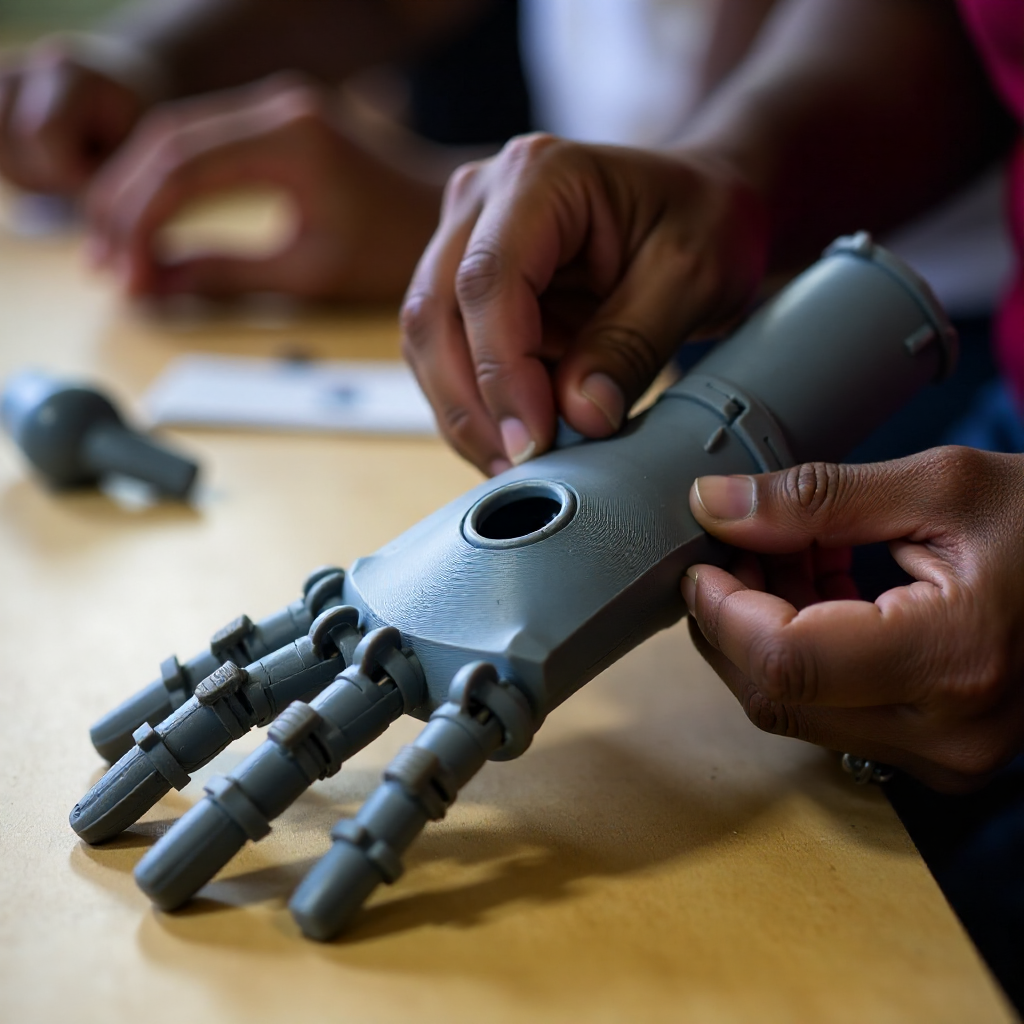
Additive manufacturing technology allows the team to iterate rapidly. A prosthetic socket that might take months to source from abroad can be designed, printed, tested, and adjusted within days. When a patient's residual limb changes shape — which is common, especially in children — the lab can reprint a new fitting without starting from scratch.
The cost difference is significant. Imported prosthetic components can run into hundreds or thousands of dollars. Locally printed versions, using materials sourced regionally where possible, can reduce that cost by 60–80% in some cases. That's not a marginal improvement — it's the difference between access and no access for most Haitian families.
Choosing local manufacturing does come with trade-offs. Material quality can be harder to standardize, and printer maintenance in a low-resource environment requires ongoing technical support. iLab Haiti addresses this by training local technicians and building maintenance capacity into every project from the start.
Key Projects and Their Impact on Communities
iLab Haiti's most visible work has been in prosthetics and assistive devices, but the lab's portfolio extends into diagnostic tools and community health worker equipment.
The prosthetics program has produced custom upper and lower limb devices for patients who had no prior access to any form of prosthetic care. Community health workers in remote areas have received 3D-printed diagnostic aids that allow them to conduct basic assessments without needing to transport patients to urban centers. In some projects, the lab has collaborated with international partners to adapt open-source medical device designs to Haitian manufacturing conditions — a practical application of the global open-hardware movement at the local level.
What's harder to quantify — but equally important — is the shift in how communities perceive their own capacity. When residents see that a device was designed and built by Haitians, for Haitians, using machines in their own city, the psychological impact runs deep. Local ownership of healthcare solutions builds trust in ways that imported products simply cannot replicate.
The Design Thinking Process Behind iLab Haiti's Solutions
Design thinking at iLab Haiti is not a workshop exercise — it's the operational backbone of every project. The process follows a recognizable human-centered design loop, but adapted to the specific constraints and rhythms of Haitian community life.
It begins with deep listening. Before any prototyping happens, the team spends time with community health workers, patients, and local medical staff to understand the actual problem — not the assumed one. This distinction matters enormously. A device that solves the wrong problem, however technically impressive, helps no one.
From there, the process moves through rapid ideation, low-fidelity prototyping, and structured feedback cycles. The team might produce three or four versions of a device before arriving at something that genuinely works in the field. Each iteration is tested by the people who will use it, and feedback is incorporated directly — not filtered through layers of institutional bureaucracy.
The final phase — which many innovation labs neglect — is sustainability planning. Who will maintain this device? Who can repair it? Where will replacement parts come from? These questions are built into the design process from day one, not added as an afterthought.
Challenges, Lessons Learned, and the Road Ahead
iLab Haiti operates in one of the world's most difficult environments for sustained innovation work. Power outages, political instability, supply chain disruptions, and funding uncertainty are not edge cases — they are the baseline conditions.
One of the lab's hard-won lessons is that resilience must be designed into the organization itself, not just into its products. This means maintaining multiple supplier relationships, training redundant technical capacity, and building financial buffers that allow work to continue during periods of external disruption.
Another lesson: the temptation to scale too quickly is real, and resisting it is wise. A solution that works beautifully in one neighborhood may need significant adaptation before it functions in a different community with different resources and social dynamics. iLab Haiti has learned to prioritize depth of impact over breadth of reach — at least in the short term.
Looking ahead, the lab is exploring expanded partnerships with regional universities and international fabrication networks to strengthen its technical capacity. The goal is not to grow into a large institution but to deepen its roots and expand what's possible within the communities it already serves.
Why iLab Haiti's Model Matters Beyond Its Borders
iLab Haiti's community-first, locally manufactured approach to medical accessibility offers a replicable framework for underserved regions worldwide — not just a Haitian success story.
The core insight is straightforward: when communities own the means of producing their own solutions, those solutions are more likely to be used, maintained, and improved over time. This stands in contrast to the traditional aid model, where external organizations design products in high-income contexts and ship them into low-resource environments, often with limited understanding of how they'll actually be used.
Social innovation labs in sub-Saharan Africa, Southeast Asia, and Latin America are watching iLab Haiti's model closely. The combination of design thinking, additive manufacturing, and genuine community partnership is not resource-intensive to replicate — it requires commitment, local knowledge, and patience more than it requires capital.
The World Health Organization estimates that over 2.5 billion people globally need one or more assistive products, yet fewer than 1 in 10 who need them have access. iLab Haiti's work points toward one credible path for closing that gap — not through charity, but through locally owned, technology-enabled production.
What iLab Haiti demonstrates, above all, is that innovation doesn't require perfect conditions. It requires the right process, the right relationships, and the conviction that the people closest to a problem are best positioned to solve it.
Frequently Asked Questions
What types of medical supplies has iLab Haiti produced with 3D printing?
iLab Haiti has used 3D printing to produce prosthetic limb components, orthotic supports, and diagnostic aids for community health workers. The lab focuses on devices that are high-need, locally repairable, and difficult to source through conventional import channels.
How does iLab Haiti involve local communities in the design process?
Community involvement begins at the needs assessment stage — before any design work starts. Patients, community health workers, and local medical staff participate in defining the problem, testing prototypes, and providing feedback at each iteration. This ensures solutions reflect actual use conditions rather than assumptions made from outside.
Is iLab Haiti's model scalable to other countries with limited healthcare infrastructure?
Yes, with adaptation. The core elements — design thinking methodology, local fabrication capacity, and community partnership — are transferable. What requires careful attention is the localization of each element to fit the specific social, economic, and technical context of a new region. Direct copy-paste replication rarely works; principled adaptation does.
How does local production of medical devices compare in cost to importing them?
In iLab Haiti's experience, locally 3D-printed medical devices can cost 60–80% less than imported equivalents in some categories. The savings come from eliminating import costs, customs fees, and intermediary markups. The trade-off is that local production requires upfront investment in equipment, training, and quality control processes.
How can organizations or individuals support or collaborate with iLab Haiti?
Organizations can explore partnership opportunities around technical training, open-source device design, or co-development of new medical tools suited to low-resource environments. Individuals with expertise in engineering, healthcare, or social innovation can connect with the lab directly. Financial support helps sustain operations during the periods of instability that are an unavoidable part of working in Haiti.