How Social Innovation is Transforming Healthcare in Haiti — One Lab at a Time
Haiti's Healthcare Gap and Why Standard Solutions Fall Short
Haiti faces one of the most complex healthcare access challenges in the Western Hemisphere — not simply because of poverty, but because of deeply structural issues: fragmented infrastructure, frequent natural disasters, and a chronic dependency on external supply chains that break down precisely when they're needed most.
Imported medical equipment arrives late, breaks down without replacement parts, and is rarely designed with Haitian realities in mind. A wheelchair built for flat hospital corridors doesn't perform on unpaved rural paths. A diagnostic tool requiring stable electricity becomes useless where power cuts last for hours. Standard, top-down aid models address the symptom — the missing supply — without touching the system that keeps creating the gap.
What the country needs isn't more external donations. It needs the capacity to design, produce, and iterate on its own terms. That shift in thinking is where social innovation enters.
What Social Innovation Actually Means in a Haitian Context
Social innovation is the process of developing new approaches to social challenges that are more effective, sustainable, and community-owned than existing alternatives. In Haiti, this distinction matters enormously.
The difference between charity and social innovation isn't just philosophical — it's structural. Charity delivers a solution. Social innovation builds the capacity to find solutions. One creates dependency; the other builds agency. In a context where external aid has historically reinforced cycles of dependency, community ownership of the innovation process is not a nice-to-have. It's the whole point.
In practical terms, social innovation in Haiti means starting with the community's own knowledge of its problems, using accessible tools to prototype responses, testing those responses in real conditions, and refining them based on what actually works. The community isn't the beneficiary at the end of a pipeline — it's the driver throughout.
This is also why sustainability looks different here. A solution doesn't become sustainable because it's well-funded. It becomes sustainable when local actors can maintain, adapt, and teach it without outside intervention.
iLab Haiti — Where Technology Meets Community Needs
iLab Haiti is a locally rooted innovation lab that operates at the intersection of technology, design, and community health. Its mission is to equip Haitian changemakers — students, health workers, entrepreneurs, and technicians — with the tools and methodology to build solutions for their own communities.
What sets iLab Haiti apart from a typical tech incubator is context-sensitivity. The lab doesn't import Silicon Valley frameworks and apply them wholesale. It adapts. Design sprints are run in Haitian Creole. Prototypes are tested in the neighborhoods where they'll actually be used. Community health workers are included in the design process, not consulted after the fact.
The lab focuses on resource-constrained environments as the design condition, not the obstacle. Working with limited materials, intermittent power, and supply chain uncertainty isn't treated as a problem to work around — it's the baseline that forces smarter, more resilient design. That constraint-driven creativity is precisely what makes the lab's output relevant far beyond Haiti's borders.

3D Printing as a Tool for Local Medical Production
3D printing gives communities the ability to manufacture functional objects locally, on demand, without a global supply chain — and in healthcare, that capability changes what's possible.
At iLab Haiti, additive manufacturing is used to prototype and produce medical supplies and assistive devices that would otherwise need to be imported at significant cost and delay. The practical advantages are real: a 3D-printed splint or prosthetic component can be produced in hours, customized to the patient's anatomy, and reprinted if it breaks. Compare that to waiting weeks for an international shipment that may or may not arrive intact.
The technology also enables medical device prototyping that is iterative by nature. A design can be tested, modified, and reprinted the same day based on feedback from the person using it. This rapid cycle — prototype, test, refine — is simply not possible with traditional manufacturing in a low-resource setting.
That said, 3D printing is a tool, not a solution in itself. The quality of what gets printed depends entirely on the quality of the design process behind it. This is where design thinking becomes essential.
Design Thinking as a Healthcare Problem-Solving Framework
Design thinking is a human-centered problem-solving methodology that starts with deep understanding of the user's experience before proposing any solution. In healthcare, this means identifying what patients and community health workers actually struggle with — not what outside observers assume they need.
The process typically moves through five stages: empathize, define, ideate, prototype, and test. In practice at iLab Haiti, the empathy phase is not a formality. It involves extended conversations with community members, observation in real care settings, and careful attention to the gap between what people say they need and what they actually do in context. That distinction frequently surfaces problems that no external needs assessment would have caught.
Applied to the Haiti healthcare system, this methodology has produced genuinely different starting points for solutions. When the community defines the problem — not the funder, not the NGO — the resulting product tends to fit. It fits the language, the physical environment, the available maintenance skills, and the cultural context of how care is actually delivered.
Human-centered design also builds trust. When community members participate in defining a problem and testing a solution, they understand it, they own it, and they're far more likely to use and maintain it over time. That's not a soft outcome — it's the mechanism through which a prototype becomes a lasting health intervention.
From Prototype to Impact — Community Projects in Action
The path from a design concept to a deployed health solution is rarely linear, and iLab Haiti's approach embraces that messiness rather than hiding it.
Community projects typically begin with a problem identified by local health workers or patients — a missing piece of equipment, a process that fails regularly, a need that no existing product addresses. From there, a cross-functional team (often including students, technicians, and the community members who raised the issue) enters a rapid ideation phase, sketching solutions and stress-testing assumptions before any physical prototyping begins.
Once a concept shows promise, the 3D printer becomes an active part of the conversation. Physical prototypes make abstract ideas tangible and testable. A community health worker can hold a device, try to use it in conditions that approximate real use, and immediately articulate what works and what doesn't. That feedback loop — faster and more honest than any survey — drives the iteration.
The final deployed solution often looks quite different from the initial concept. That's not a failure of the process; it's evidence that the process worked. The goal was never to deliver a predetermined product — it was to solve a real problem for real people, and to do it in a way the community can sustain independently.
What This Model Can Teach the World About Resilient Health Systems
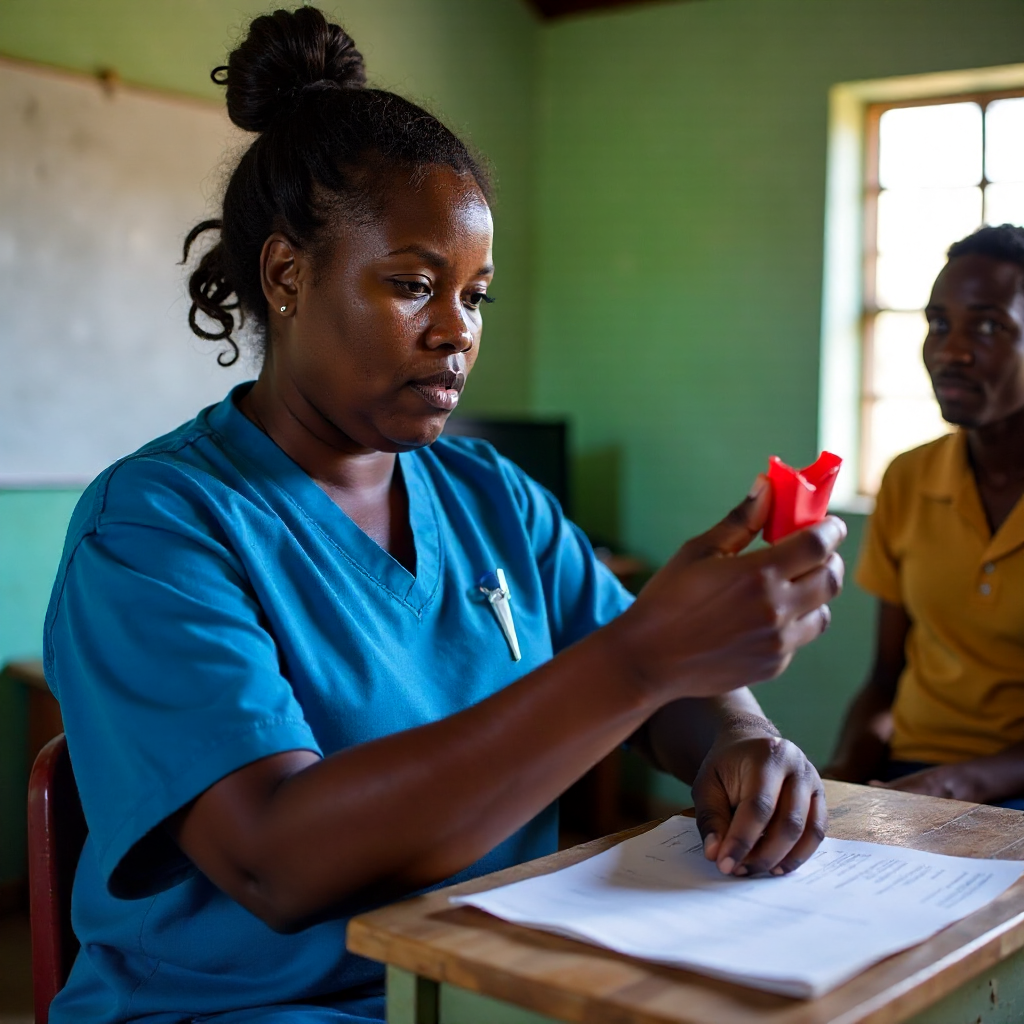
The iLab Haiti model — community-owned, constraint-driven, iterative, and locally produced — is not just a response to Haiti's specific challenges. It's a blueprint for any environment where conventional health system assumptions don't hold.
Across sub-Saharan Africa, Southeast Asia, and underserved regions within wealthier nations, the same structural vulnerabilities apply: fragile supply chains, equipment designed for different contexts, and solutions developed far from the communities that need them. The iLab approach addresses all three by inverting the design process — starting local and scaling outward rather than the reverse.
The transferable principles are concrete. Invest in local fabrication capacity, not just in imported products. Train community members as designers and problem-solvers, not just as end users. Use design thinking to define problems before committing to solutions. Accept iteration as a feature, not a delay. These principles don't require large budgets — they require a different philosophy about who gets to design health systems and for whom.
Haiti is often discussed in terms of what it lacks. iLab Haiti is evidence of what becomes possible when the conversation shifts to what a community can build. That shift in framing may be the most transferable innovation of all.
Frequently Asked Questions
What is iLab Haiti and what does it do?
iLab Haiti is a locally operated innovation lab focused on equipping Haitian communities with technology tools and design methodologies to develop their own solutions to health and social challenges. It runs design workshops, supports prototyping projects, and builds local technical capacity through hands-on training and community collaboration.
How is 3D printing used to improve healthcare in Haiti?
3D printing at iLab Haiti enables local production of medical supplies, assistive devices, and equipment components that would otherwise need to be imported. It reduces cost, eliminates shipping delays, and allows designs to be customized for individual patients or adapted quickly based on real-world testing.
What is design thinking and how does it apply to social innovation in health?
Design thinking is a problem-solving methodology that prioritizes deep understanding of the user's actual experience before developing solutions. In healthcare social innovation, it ensures that medical tools and interventions are built around real community needs rather than assumed ones — increasing both relevance and adoption.
How does local production of medical supplies help Haitian communities?
Local production reduces dependency on international supply chains that are vulnerable to disruption from logistics failures, natural disasters, or funding gaps. When communities can manufacture and repair their own supplies, health systems become more resilient and sustainable over time — independent of external conditions.
Can the iLab Haiti model be replicated in other countries?
Yes. The core principles — community ownership, constraint-driven design, local fabrication, and iterative development — are applicable in any resource-constrained environment. Organizations in other low- and middle-income countries have drawn on similar frameworks. What makes replication successful is not copying the tools, but adopting the underlying philosophy: design with communities, not for them.