The Role of Technology in Sustainable Local Manufacturing: Building Resilient Communities from the Ground Up
When a hospital in Port-au-Prince runs out of a critical medical component, the default solution is to wait — sometimes weeks — for an imported shipment. That delay has real consequences. But what if the solution could be designed, printed, and delivered within the same community? That shift from dependency to local production is exactly what sustainable manufacturing technology makes possible, and it's already happening.
Why Local Manufacturing Matters for Sustainability
Over-reliance on global supply chains creates fragile systems — especially in regions where disruptions hit hardest. For communities in the Global South, every imported product carries hidden costs: shipping emissions, currency exchange losses, long lead times, and zero local economic return.
The COVID-19 pandemic exposed this fragility at scale. Countries that lacked domestic production capacity for PPE, ventilators, and basic health equipment faced life-threatening shortages. The lesson wasn't just logistical — it was structural. Communities that depend entirely on external supply chains surrender control over their own resilience.
Supply chain localization addresses all three dimensions of sustainability simultaneously. Environmentally, local production cuts transportation emissions and reduces packaging waste. Economically, it keeps money circulating within the community and creates skilled jobs. Socially, it builds the kind of ownership and agency that imported goods never can.
In resource-constrained contexts, this isn't idealism — it's a practical necessity. The question is no longer whether local manufacturing matters, but how to make it viable.
How Technology Is Changing What "Local" Can Produce
Digital fabrication tools have fundamentally lowered the barrier to local production, allowing small teams with modest budgets to manufacture goods that once required industrial-scale facilities.
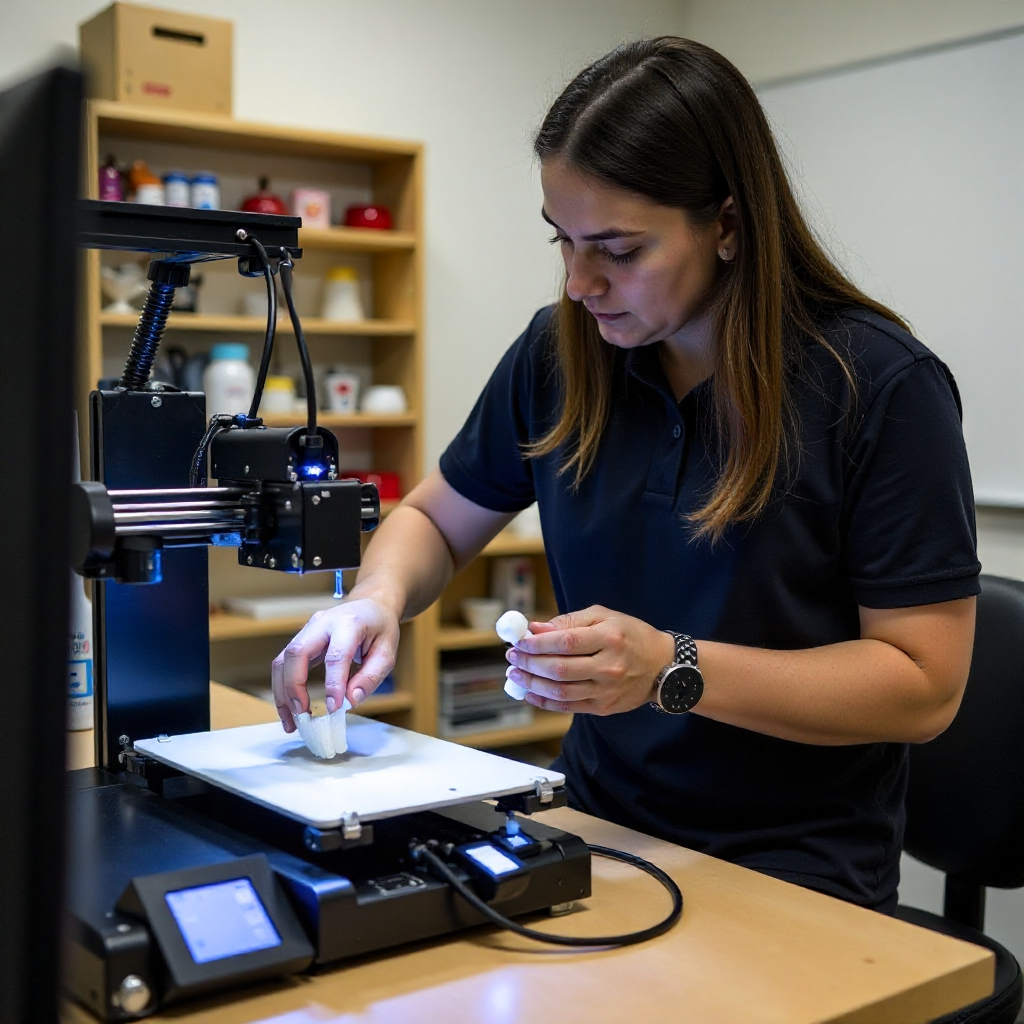
3D printing (additive manufacturing) is the most visible of these tools. A desktop FDM printer costing under $500 can produce functional prototypes, replacement parts, prosthetic components, and custom fixtures — on demand, with minimal waste. Pair that with laser cutting and open-source design libraries, and a small community workshop gains capabilities that were unimaginable a decade ago.
Open-source hardware platforms like RepRap have democratized the means of production in a meaningful way. Designs can be shared across continents, adapted locally, and printed with materials sourced regionally. This isn't theoretical — communities in Kenya, India, Colombia, and Haiti are doing exactly this.
The critical insight is that technology doesn't replace human skill — it amplifies it. A local engineer with a 3D printer and a clear problem to solve can outperform a distant factory optimizing for volume. The machine serves the person, who serves the community.
Design Thinking as the Foundation of Sustainable Innovation
Technology without the right process produces the wrong products. Design thinking ensures that locally manufactured goods actually solve the problems communities face — rather than the problems outsiders assume they have.
Traditional product development often flows from specification to prototype to market. Design thinking inverts this by starting with deep empathy: listening to end users, observing real conditions, and co-creating solutions with the people who will use them. In a local manufacturing context, this isn't just a methodology — it's what makes the difference between a product that sits unused and one that transforms daily life.
Consider prosthetic limbs. A standard imported prosthetic is designed for an average body, an average climate, and an average lifestyle. A prosthetic designed through community co-design — accounting for local terrain, local occupations, and local body proportions — fits differently. It gets used. That's the gap design thinking closes.
The process also reduces waste. When you understand the need precisely before manufacturing begins, you avoid producing the wrong thing at scale. In resource-constrained environments, that discipline isn't optional — it's survival.
From Concept to Community: Local Production of Medical Supplies
Local medical supply manufacturing is one of the highest-impact applications of sustainable production technology, particularly in countries where healthcare infrastructure is chronically underfunded.
The range of what's now producible locally is broader than most people expect. 3D-printed prosthetics, custom orthotic devices, hospital bed components, sterilization trays, PPE components, diagnostic tool housings — all of these have been manufactured in community labs using digital fabrication. The World Health Organization has recognized local production as a strategic priority for health system resilience, particularly in low- and middle-income countries.
What makes local health equipment production genuinely more sustainable than importing isn't just cost. It's responsiveness. A locally produced prosthetic can be adjusted the next day if the fit is wrong. A locally made component can be replaced within hours rather than weeks. For patients, that speed is the difference between rehabilitation and prolonged disability.
iLab Haiti has made this concrete. By training local makers to design and produce health-related equipment using 3D printing, the organization has demonstrated that high-quality, appropriate medical supplies can be manufactured within the communities that need them most.
iLab Haiti: A Model for Tech-Enabled Local Manufacturing
iLab Haiti represents something rare: a living proof of concept for technology-enabled, community-rooted social innovation. It's not a pilot program waiting for scale — it's a functioning model producing real outputs for real people.
The approach combines three elements that are often treated separately but work best together. First, digital fabrication infrastructure — 3D printers, design software, and fabrication tools — gives local makers the physical means to produce. Second, design thinking methodology ensures that what gets produced is genuinely needed and appropriately designed. Third, and most importantly, local talent is at the center. iLab Haiti doesn't import expertise and leave — it builds it.
This combination produces a compounding effect. Each project builds local skills. Each skill-building session expands the community's capacity to take on more complex problems. Each solution produced demonstrates to the broader community that local manufacturing is viable — which attracts more participants, more problems, and more solutions.
The circular economy dimension is real here too. By sourcing materials locally where possible and designing for repairability rather than disposal, iLab Haiti's production model generates less waste and keeps more value within Haiti's economy. That's not a side benefit — it's built into the design philosophy.
Challenges and How They Are Overcome
Sustainable local manufacturing is genuinely hard, and pretending otherwise would undermine the credibility of everything else said here. The barriers are real: materials sourcing, skills gaps, equipment maintenance, funding continuity, and quality assurance all require ongoing attention.
Materials are often the first friction point. Filament for 3D printing, electronics components, and specialty hardware may not be locally available, creating the same import dependency the model is trying to reduce. The practical response is a tiered approach: maximize local sourcing for what's available, build strategic stockpiles for what isn't, and invest in developing local material supply chains over time.
Skills gaps are addressed through iteration rather than perfection. New makers don't need to master everything before they contribute — they need structured learning pathways that build competence progressively. iLab Haiti's approach of pairing experienced makers with newcomers on real projects compresses that learning curve significantly.
Equipment maintenance is often underestimated. A 3D printer that breaks down without a local technician to fix it becomes an expensive paperweight. Building maintenance capacity alongside fabrication capacity is non-negotiable — and it's a skills investment that pays dividends across many machines and many years.
Funding is the most persistent challenge. Grant cycles don't always align with production cycles, and community labs need operational continuity to build momentum. The most durable models develop mixed revenue: grants for capacity building, earned income from production contracts, and community contributions that build ownership.
Scaling the Model: What Other Communities Can Learn
The principles that make iLab Haiti's approach work are not specific to Haiti — they're transferable to any community willing to invest in local capacity over external dependency.
Three principles stand out as most replicable. The first is problem-first sequencing: start with a real, pressing community need rather than with the technology. The printer is a tool; the problem is the point. Communities that begin with clear problem statements attract more sustained engagement than those that begin with equipment demonstrations.
The second is radical local ownership. External partners, funders, and technical advisors all have roles to play — but the community must own the process, the decisions, and the outputs. This isn't just ethically important; it's practically necessary for sustainability. Projects that depend on external management don't outlast the external managers.
The third is iterative ambition. Start small enough to succeed, learn from what works and what doesn't, and expand deliberately. A community lab that successfully produces 10 products well is better positioned to grow than one that attempts 50 products and delivers none reliably.
The broader movement toward community resilience through digital fabrication and social innovation is gaining momentum globally. iLab Haiti's model shows that the constraints of a low-resource environment don't prevent innovation — they focus it. And focused innovation, rooted in real community needs, produces solutions that actually last.
Frequently Asked Questions
What types of products can be sustainably manufactured locally using 3D printing?
3D printing enables local production of prosthetics, orthotic devices, medical equipment components, replacement parts for machinery, educational tools, agricultural implements, and custom fixtures. The key is matching the production method to the material requirements — not every product is appropriate for additive manufacturing, but the range is wider than most expect.
How does design thinking differ from traditional product development in a local manufacturing context?
Traditional product development typically starts with a specification defined by engineers or managers. Design thinking starts with the end user — through interviews, observation, and co-creation. In a local manufacturing context, this means the community shapes what gets built, which dramatically increases the likelihood that the product will actually be used and maintained.
What makes local medical supply production more sustainable than importing?
Local production eliminates shipping emissions, reduces lead times from weeks to hours, keeps economic value within the community, and allows for rapid customization and repair. Imported medical supplies are designed for average conditions; locally produced ones can be designed for the specific patient, environment, and use case.
How can communities without advanced infrastructure adopt digital fabrication?
Entry-level 3D printers operate on standard electrical power and require only a laptop and open-source software to function. Many successful community labs have started with a single machine, a small team, and a specific problem to solve. Infrastructure constraints are real but rarely absolute — the bigger requirement is committed local leadership and a clear community need to anchor the work.
What is iLab Haiti and what has it produced for its community?
iLab Haiti is a social innovation lab that combines 3D printing, design thinking, and community co-design to produce locally appropriate solutions — including medical equipment and health supplies — for Haitian communities. It trains local makers, builds fabrication capacity, and demonstrates that high-quality, sustainable local manufacturing is achievable in resource-constrained environments.